
Media Leaders Discuss the Changing Media Landscape in Collin County
October 06, 2023
Cougar News
Back to Newsroom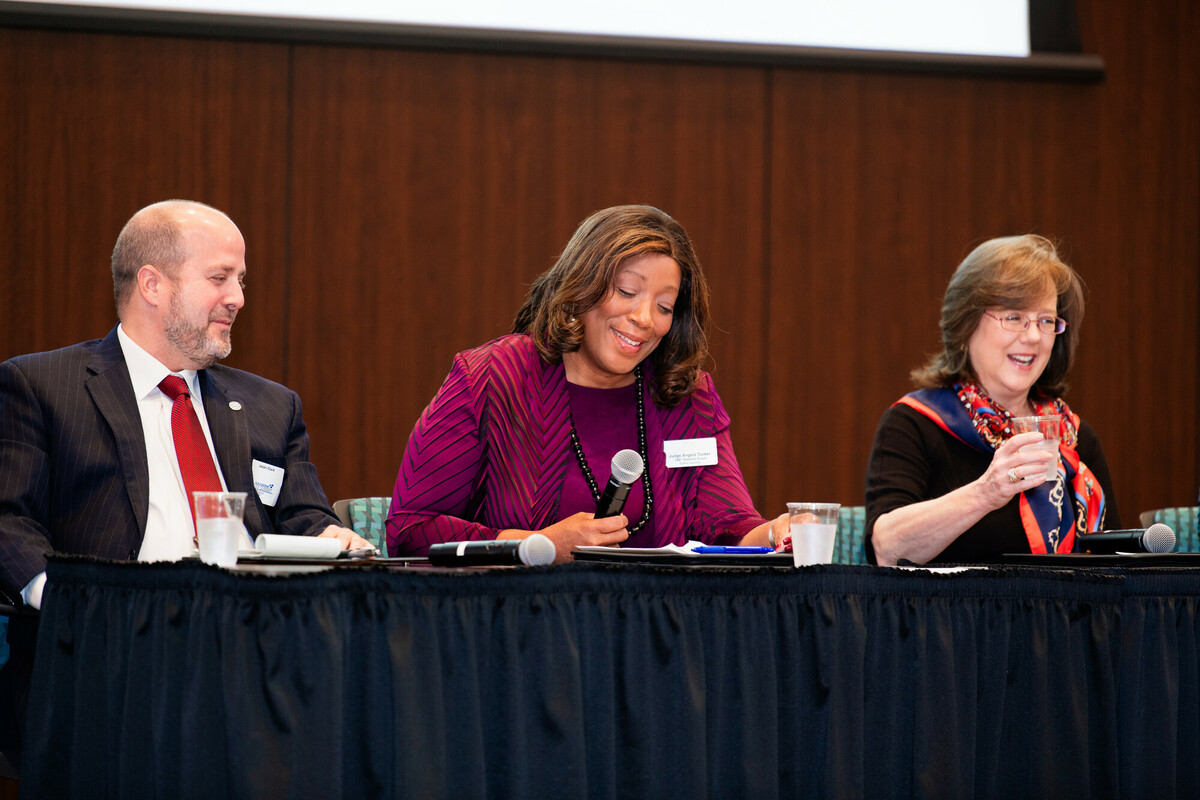
Changing consumer preferences, fewer traditional media outlets, and the challenges in providing comprehensive coverage to subscribers were among the many topics discussed at “The Changing Media Landscape in Collin County” panel discussion at the 2023 Collin Leadership Policy Summit held at the Collin College McKinney Campus in October.
This panel included Chief Executive Officer of the Fort Worth Report Chris Cobler, Publisher of C&S Media Publications Chad Engbrock, Chief Executive Officer of Noir Lifestyles of Collin County June Jenkins, and Managing Director of Sunwest Communications Rebecca Rodriguez with Collin College Senior Vice President of External Relations Steve Matthews as the moderator.Matthews set the stage for the discussion by outlining the challenges faced by Collin County public and private sector organizations to communicate information with their stakeholders as the media landscape undergoes dramatic change, a particular challenge in Collin County with more than one million residents, a growing business base, and limited established media outlets.
New Nonprofit Media Model in Fort Worth
Cobler shared the story behind how he became the publisher and CEO of the nonprofit, digital Fort Worth Report.
“Business and community leaders in Fort Worth and Tarrant County said, ‘What do we do about the fact that Fort Worth is booming — 2.1 million people in the county — we have so much going on, but it’s not being covered at the level that it used to be,’ and they really value local journalism and wanted to figure out a new model for supporting it,” said Cobler, who mentioned that there are more than 400 local nonprofit newsrooms as part of the Institute for Nonprofit News.
“The reason being, again, that our democracy and our communities really rest on people trusting local news, … trusting information, being connected to each other in places where there are news deserts, where there is no local journalism, and unfortunately over the last 20 years or so there have been a lot of those. I mean more than 2,000 newspapers have closed during that time, and in those places they’ve gone in and studied it and found that civic engagement goes down, people vote less, they are less trusting of each other, government taxes and corruption go up, hyper partisanship goes up, people become more polarized, and so Fort Worth leaders said, ‘We don’t want that to happen here,’ … and we started in April 2021 with a small staff of six. Since then, the community has received us so favorably and supported us financially so much that we’ve more than tripled our staff,” Cobler said.
Comprehensive media coverage successes and challenges
According to Engbrock, publisher for a group of newspapers on the east side of Collin County, his papers have a base direction for all the communities they serve though the cost of paying for coverage has increased.
“We still cover every city council meeting … we are at every school board meeting, and we are at as many events in the community as possible. In addition to staff, we use a number of stringers, or freelancers, both on the photography and writing sides. Many of our freelancers are gentlemen or women who have been in the industry before and either got out or lost their jobs, so we are fortunate to have experience when we send someone out,” said Engbrock who added that his organization is paying 100 percent more now for hiring a reporter than it did five years ago.
Rodriguez, who began her career as a journalist and now advises clients about working with the media, shared how she has changed her procedures to improve opportunities for media coverage.
“As a PR [Public Relations] person, you are prepared to do a lot more work. You do more one-on-one pitching, but it also provides you an opportunity to tell your story the way you want to tell it because when you find a journalist who is eager to make that connection you have someone who is more eager to listen and perhaps to be more open to an idea,” Rodriguez said.
Filling a Niche
Jenkins, founder and publisher of Noir Lifestyles of Collin County, shared how her magazine and newsletter were created to fill the void for people of color in Collin County.
“I came to Collin County back in 1986. I was a corporate relocator for EDS [Electronic Data Systems] … and when I came here what I noticed was that I did not see anything that had something that looked like me on it … what I noticed is that the media came to us on three occasions: Martin Luther King weekend, Black History Month, and most recently Juneteenth, and outside of that our story was not being told,” Jenkins said. “What we try to do in the magazine is to tell the stories about people amongst our community, our teachers, our everyday heroes that are out there doing the things to make the community of Collin County the great county that it is,” she said.
Before closing the panel session, Matthews challenged the audience to reflect on what could be done to support the growth of journalism and the media outlets that currently exist in the county.
To view the video of this panel session, click here. For more information about the 2023 Collin Leadership Policy Summit, visit www.collin.edu/policysummit/.
Back to Newsroom